Can a computer learn to read your numbers?
A game in five short stages. Beat the computer at reading handwriting.
 @seawan · · Updated 2026-11-04 · 2 min read · code & data · ✓ Delta-reproducible
#The question
Can a computer learn to read handwritten digits just by looking at examples? Play to find out, and see if you can beat it. Your progress is kept on this device.
#Specs: system & compute
| Deployment | domestic |
|---|---|
| Image | PyTorch CUDA13 (GPU) |
| CPU | 2 |
| Memory | 8Gi |
| GPU | 1 × GPU (8000 MiB each) |
| Run time | 1 min 26 s |
| Run ID | eee905f2426a49f890b5fea94906e78b |
| Date | 2026-11-01 |
| Packages | 50 packagesanyio==4.16.0, click==8.5.0, contourpy==1.3.2, cycler==0.12.1, exceptiongroup==1.3.1, filelock==3.29.0, fonttools==4.65.0, fsspec==2026.4.0, h11==0.16.0, hf-xet==1.8.0, httpcore2==2.14.0, httpx2==2.14.0, huggingface_hub==2.4.0, idna==3.20, Jinja2==3.1.6, kiwisolver==1.5.1, MarkupSafe==3.0.3, matplotlib==3.10.9, mpmath==1.3.0, networkx==3.4.2, numpy==2.2.6, nvidia-cublas-cu12==12.1.3.1, nvidia-cuda-cupti-cu12==12.1.105, nvidia-cuda-nvrtc-cu12==12.1.105, nvidia-cuda-runtime-cu12==12.1.105, nvidia-cudnn-cu12==9.1.0.70, nvidia-cufft-cu12==11.0.2.54, nvidia-curand-cu12==10.3.2.106, nvidia-cusolver-cu12==11.4.5.107, nvidia-cusparse-cu12==12.1.0.106, nvidia-nccl-cu12==2.21.5, nvidia-nvjitlink-cu12==12.9.86, nvidia-nvtx-cu12==12.1.105, packaging==26.3, pillow==12.2.0, pyarrow==25.0.1, pyparsing==3.3.3, python-dateutil==3.0.0, PyYAML==6.0.3, six==1.17.0, sympy==1.13.1, tomli==2.5.0, torch==2.5.1+cu121, torchaudio==2.5.1+cu121, torchvision==0.20.1+cu121, tqdm==4.70.1, triton==3.1.0, truststore==0.10.5, typing_extensions==4.16.0, tzdata==2026.6 |
Recorded from the actual Delta run, not typed by hand.
#What we did
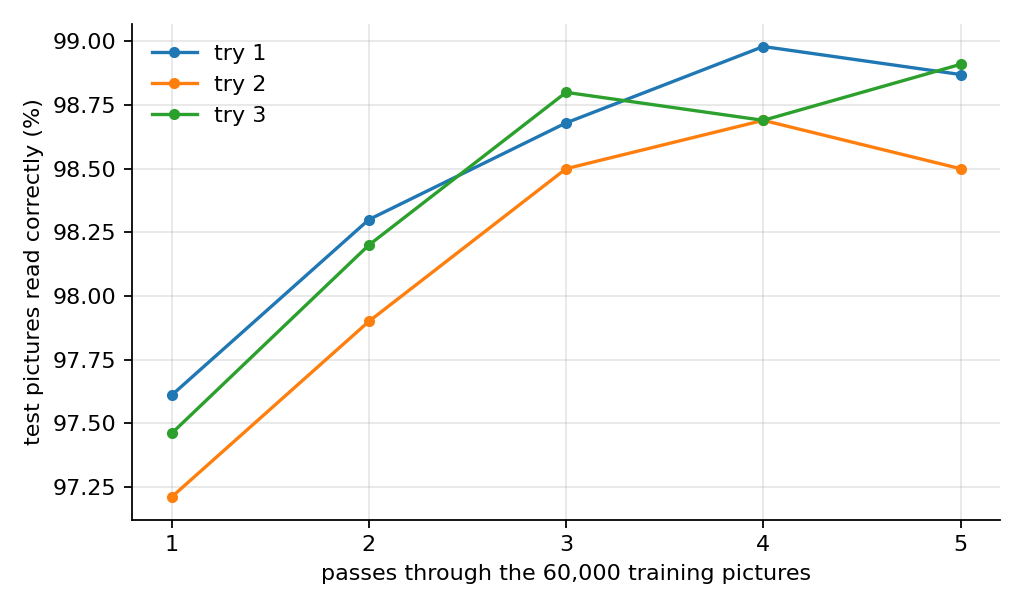
A neural network learned from 60000 labelled pictures of digits from a collection called MNIST, in 5 practice rounds. We tested it on 10000 separate pictures it never practised on, and repeated all of this 3 times from different random starts.
        for start in range(0, len(order), BATCH_SIZE):
            batch = order[start:start + BATCH_SIZE]
            loss = F.cross_entropy(model(train_x[batch]), train_y[batch])
            optimizer.zero_grad()
            loss.backward()
            optimizer.step()
#Results
After practice, the networks read an average of 98.76% correctly: about 124 mistakes in 10000 pictures.
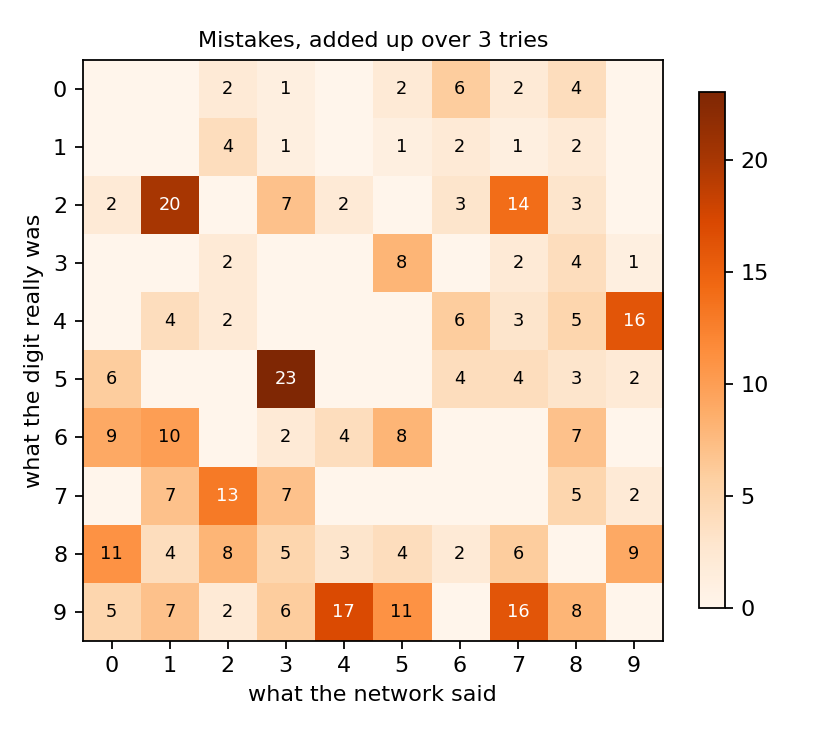
| The digit really was | The network said | Times across all 3 tries |
|---|---|---|
| 5 | 3 | 23 |
| 2 | 1 | 20 |
| 9 | 4 | 17 |
| 4 | 9 | 16 |
| 9 | 7 | 16 |
| 2 | 7 | 14 |
#What this does and doesn't show
- Only tidy, single digits. The pictures were centred and one size. We did not test envelopes, words or whole pages.
- One design. We tried this network from 3 starting points, not lots of designs.
- Counts, not causes. We can see which mix-ups happened, but not prove why, and we can't tell why two scores dipped in the last round.
- Reading isn't understanding. Matching a picture to a label says nothing about counting or adding.
Code & data
Everything needed to check the numbers above. Click a file to read it here, with line numbers.
#Author verification
✓ Signed by @seawan on
I played all five stages and read the whole post to make sure a child can follow it. I checked that the main numbers match the results file from the Delta run, and that the post has the Delta-reproducible badge and run record.
Written by the author, not generated. The build only checks that it is present.
References
- Y. Lecun, L. Bottou, Y. Bengio and P. Haffner. Gradient-based learning applied to document recognition. Proceedings of the IEEE, 1998. doi:10.1109/5.726791 ✓ verified (Crossref)
- Diederik P. Kingma and Jimmy Ba. Adam: A Method for Stochastic Optimization. 2014. arXiv:1412.6980 ✓ verified (arXiv)
Every reference above was checked by an automated script against arXiv, Crossref or Semantic Scholar (title, authors, year), and the cited claim was compared against the paper's abstract.
#Reproduce
✓ Delta-reproducible
npx -y github:seawan/vibe-research#0fae223b2dded3030a8738c721afc659672ee84f seawan/teach-a-computer-to-read-digitsPinned to the commit that last changed this post. Rerun spec: delta.yaml. Resources: 2 CPU · 8Gi memory · GPU: 1 × GPU (8000 MiB each) · up to 60 min · domestic.
Need Delta? Register for delta-cli first.
This is a “vibe research” report: the experiments and the write-up were produced with help from an AI assistant and checked by the author. Numbers come from the linked code and data; references were machine-verified.