Can tidy dots help you find a circle’s secret number?
A game in five short stages. Throw pretend darts, then race two teams to find pi.
 @seawan · · Updated 2026-11-04 · 3 min read · code & data · ✓ Delta-reproducible
#The question
Can tidy dots help you find a circle's secret number? Play to find out. Your progress is kept on this device.
#Specs: system & compute
| Deployment | domestic |
|---|---|
| Image | PyTorch CUDA13 (GPU) |
| CPU | 2 |
| Memory | 8Gi |
| GPU | 1 × GPU (8000 MiB each) |
| Run time | 1 min 23 s |
| Run ID | 1d2021b47c2149b09373698ffc570f77 |
| Date | 2026-11-02 |
| Packages | 36 packagescontourpy==1.3.2, cycler==0.12.1, filelock==3.29.0, fonttools==4.65.0, fsspec==2026.4.0, Jinja2==3.1.6, kiwisolver==1.5.1, MarkupSafe==3.0.3, matplotlib==3.10.9, mpmath==1.3.0, networkx==3.4.2, numpy==2.2.6, nvidia-cublas-cu12==12.1.3.1, nvidia-cuda-cupti-cu12==12.1.105, nvidia-cuda-nvrtc-cu12==12.1.105, nvidia-cuda-runtime-cu12==12.1.105, nvidia-cudnn-cu12==9.1.0.70, nvidia-cufft-cu12==11.0.2.54, nvidia-curand-cu12==10.3.2.106, nvidia-cusolver-cu12==11.4.5.107, nvidia-cusparse-cu12==12.1.0.106, nvidia-nccl-cu12==2.21.5, nvidia-nvjitlink-cu12==12.9.86, nvidia-nvtx-cu12==12.1.105, packaging==26.3, pillow==12.2.0, pyparsing==3.3.3, python-dateutil==3.0.0, six==1.17.0, sympy==1.13.1, torch==2.5.1+cu121, torchaudio==2.5.1+cu121, torchvision==0.20.1+cu121, triton==3.1.0, typing_extensions==4.15.0, tzdata==2026.6 |
Recorded from the actual Delta run, not typed by hand.
#What we did
Guessing with random dots is called a Monte Carlo method [1]. Team Halton uses a Halton sequence, a recipe of evenly spread points [2].
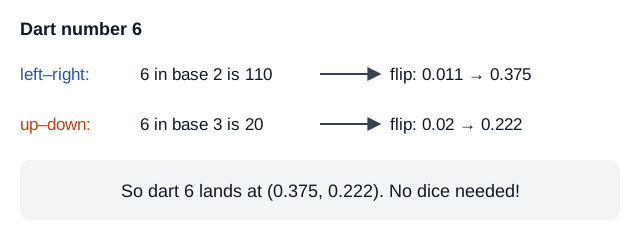
We started with 64 darts and doubled up to just over a billion, playing 50 games at each size. Before each game we slid the Halton pattern by a random amount, with darts wrapping around the edges [3]. We then compared each team's average miss.
def inside_circle(x, y):
    """True for each point inside the quarter circle (distance from the corner <= 1)."""
    return x * x + y * y <= 1.0
#Results
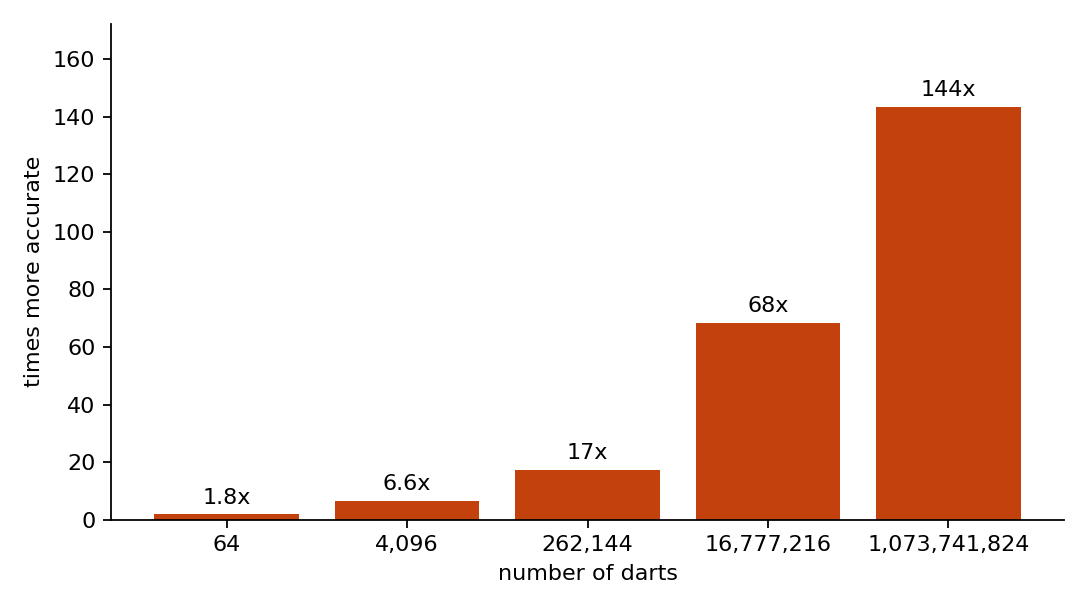
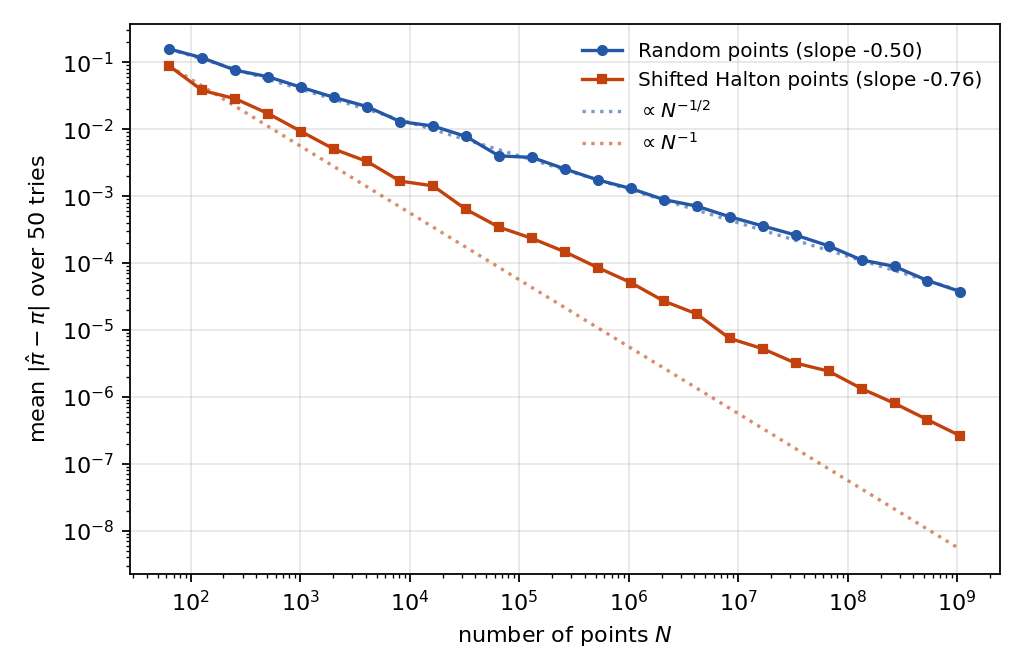
Team Halton had the smaller average miss at every size we tested, and its lead grew.
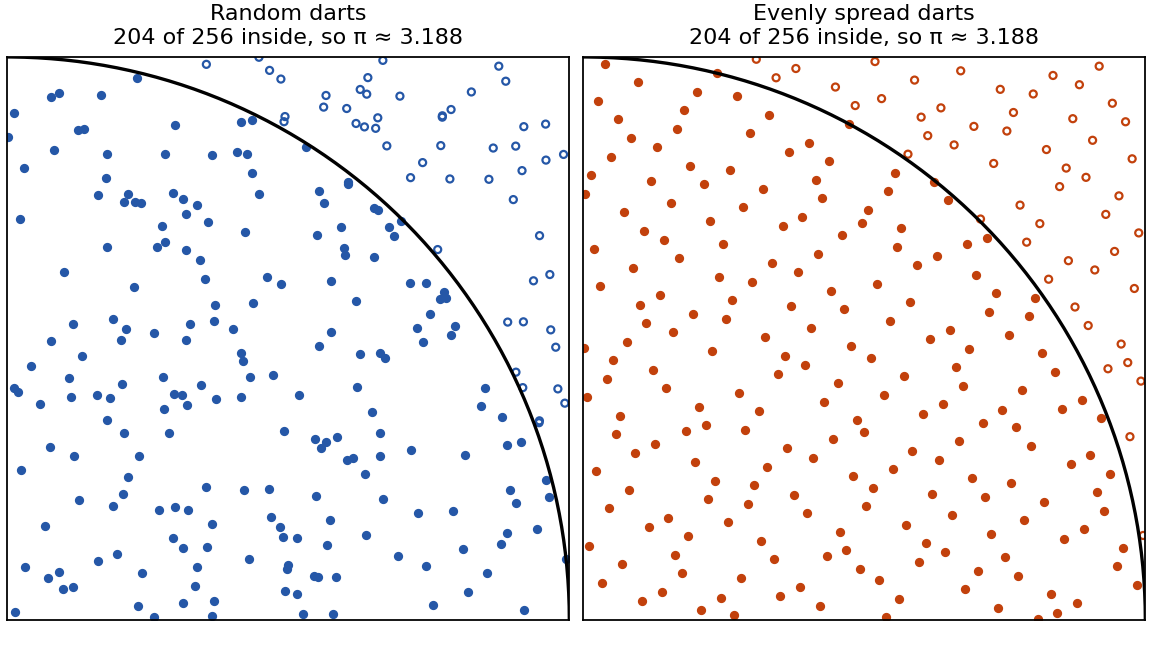
| Number of darts | Team Random's guess | Team Halton's guess |
|---|---|---|
| 64 | 3.1875 | 3.125 |
| 262,144 | 3.1396636963 | 3.1419067383 |
| about a billion | 3.1416619085 | 3.1415923089 |
| The real pi | 3.1415926536 | 3.1415926536 |
These guesses are from a single game. At about a billion darts, Team Halton's average miss over 50 games was about 143.6 times smaller.
#What this does and doesn't show
- One shape on a flat square. Other shapes, recipes and puzzles could behave differently.
- A trend is a clue, not a rule forever. Our lines describe only the sizes we tried.
- Rounding. We did not separately test whether tiny rounding effects changed the last few results.
- The tricky edge. Only darts near the curved edge can tip from inside to outside. We did not prove that this caused the pace we saw.
Code & data
Everything needed to check the numbers above. Click a file to read it here, with line numbers.
#Author verification
✓ Signed by @seawan on
I played all five stages and read the whole post to make sure a child can follow it. I checked that the main numbers match the results file from the Delta run, and that the post has the Delta-reproducible badge and run record.
Written by the author, not generated. The build only checks that it is present.
References
- Nicholas Metropolis and S. Ulam. The Monte Carlo Method. Journal of the American Statistical Association, 1949. doi:10.1080/01621459.1949.10483310 ✓ verified (Crossref)
- J. H. Halton. On the efficiency of certain quasi-random sequences of points in evaluating multi-dimensional integrals. Numerische Mathematik, 1960. doi:10.1007/bf01386213 ✓ verified (Crossref)
- R. Cranley and T. N. L. Patterson. Randomization of Number Theoretic Methods for Multiple Integration. SIAM Journal on Numerical Analysis, 1976. doi:10.1137/0713071 ✓ verified (Crossref)
- Harald Niederreiter. Random Number Generation and Quasi-Monte Carlo Methods. Society for Industrial and Applied Mathematics, 1992. doi:10.1137/1.9781611970081 ✓ verified (Crossref)
- Zhijian He and Xiaoqun Wang. On the convergence rate of randomized quasi-Monte Carlo for discontinuous functions. SIAM Journal on Numerical Analysis, 2015. doi:10.1137/15m1007963 ✓ verified (Crossref)
Every reference above was checked by an automated script against arXiv, Crossref or Semantic Scholar (title, authors, year), and the cited claim was compared against the paper's abstract.
#Reproduce
✓ Delta-reproducible
npx -y github:seawan/vibe-research#0fae223b2dded3030a8738c721afc659672ee84f seawan/monte-carlo-vs-quasi-monte-carloPinned to the commit that last changed this post. Rerun spec: delta.yaml. Resources: 2 CPU · 8Gi memory · GPU: 1 × GPU (8000 MiB each) · up to 60 min · domestic.
Need Delta? Register for delta-cli first.
This is a “vibe research” report: the experiments and the write-up were produced with help from an AI assistant and checked by the author. Numbers come from the linked code and data; references were machine-verified.